
From June 29 to July 3, 2026, InnovÉÉ InnovÉÉ led the second edition of its technical and strategic mission to Hauts-de-France, organised in partnership with Pôle MEDEE.
Thie mission, co-funded by the Commission permanente de coopération franco-québécoise (CPCFQ) as a part of the ARCÉÉ project and by InnovÉÉaimed to strengthen Franco-Québec collaborations in research and innovation in strategic areas such as electric energy, power electronics, transportation electrification and industrial technologies.
Over five days, delegation members met with researchers, industry representatives, research centres, technology transfer organisations and institutional stakeholders to discover leading-edge infrastructure, share their expertise and identify new collaboration opportunities between Québec and Hauts-de-France.
An Immersion in the Hauts-de-France Innovation Ecosystem
The mission began with a visit to VEDECOM, a research institute known for its work in electromobility, automated vehicles, bidirectional charging, induction charging and smart grids. Participants discovered several technology demonstrators showcasing the institute's advances in sustainable mobility.

The delegation then travelled to the l’Université de Technologie de Compiègne (UTC) to visit the Laboratoire Roberval and the CREMa joint laboraty with CETIM (Centre technique des industries mécaniques) dedicated to electromobility. Discussions focused on work in electromagnetism, thermal engineering, mechatronics, vibroacoustics and multiphysics systems applied to transportation.

The next day, participants continued their exploration of the French ecosystem with a visit to CETIM in Senlis. A true leader in applied research and technology transfer for the manufacturing industry, CETIM supports businesses in their innovation, product development, testing, characterisation and industrialisation projects. The delegation discovered several technology platforms dedicated to electromagnetic compatibility, vibration testing, construction equipment electrification and transmission test benches.


In the afternoon, the delegation was welcomed at EDF Lab Paris-Saclay, EDF Group's main research and development centre, to explore its laboratories dedicated to Smart Grids and power quality. The discussions provided insight into work being done on smart electrical grids, energy storage, renewable energy and the technologies that will support the transition to a more resilient, low-carbon energy system.


Applied Research and Technology Transfer
The third day featured a visit to the Laboratoire Systèmes Électrotechniques et Environnement (LSEE) as well as the Tech3E platform atUniversité d’Artois, which support technology transfer to businesses in the fields of energy efficiency and electrical systems.


The delegation then visited CRITT M2A, a regional innovation and technology transfer centre specialising in materials, microtechnologies and advanced processes. The discussions provided a better understanding of its role in supporting SMEs and industrial sectors, from applied research through to the development of concrete solutions for the benefit of businesses.


Decarbonisation, Nuclear Energy and Major Industrial Projects
The final part of the mission highlighted several key initiatives shaping France's energy transition.
Participants notably visited the Gravelines nuclear power plant, the most powerful nuclear power site in Western Europe. This immersive visit provided a better understanding of the strategic role of nuclear energy in France's energy mix, as well as the challenges related to supply security, decarbonisation and the resilience of electrical grids.

The delegation then visited EcosystemD, where they learned about the decarbonisation strategy for the Dunkirk region and the initiatives being implemented to accelerate the energy transition of this major industrial area. This visit was also an opportunity to discover research projects from IMT Nord Europe, presented by its teams, illustrating the essential role of innovation in supporting industrial transformation.


Brussels: A Strategic Workshop on Horizon Europe
The delegation also took part in a workshop on the Horizon Europeprogram, organised in collaboration with Pôle MEDEE, bringing together a European ecosystem of innovation stakeholders. The event featured the participation of two Policy Officers from the European Commission, , a representative from the Délégation générale du Québec à Bruxelles, as well as representatives from Pôle MecaTech and numerous Belgian organisations from the research, industry and innovation sectors. The day provided an opportunity to present the opportunities offered by Horizon Europe, explore calls for projects in electric energy, and foster exchanges between the Québec, French and Belgian ecosystems to help spark future international collaborations.
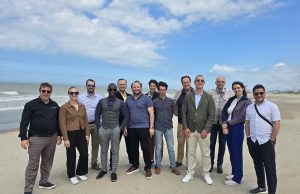
Finally, the mission concluded with a visit to the Port of Dunkirk, one of the largest ports in France, which aims to become Europe's leading port for low-carbon and transition energy. Participants learned about decarbonisation projects, new energy sectors under development, and the strategic role the port plays in the region's industrial and energy transformation.

Collaborations Focused on the Future
Beyond the technical visits, this mission helped strengthen ties between Québec and French innovation stakeholders, foster the sharing of best practices, and identify new avenues for collaboration in research, development and technology demonstration.
InnovÉÉ warmly thanks all of the host organisations — VEDECOM, UTC, Laboratoire Roberval, CREM, CETIM, EDF Lab Paris-Saclay, Université d'Artois, Tech3E, LSEE, CRITT M2A, EcosystemD, IMT Nord Europe and Dunkirk Port — for their hospitality, availability and the quality of the discussions throughout this week full of learning.
Thank you as well to the delegation members for their commitment and contribution to the success of this mission:
- Ali Aidibe – Polytechnique Montréal
- Charly Brault – Effenco
- Damien M. Tholomier – Coopérative d’électricité de Saint-Jean-Baptiste
- Elissa Haddad – Institut national de la recherche scientifique (INRS)
- François Colet – Dcbel
- Frédérick Lepage – EnerOptim
- Julianne Langlais – Levando
- Khaled Ziane – Centre de recherche et d’innovation en intelligence énergétique (CR2ie)
- Sébastien Dubus – Institut des matériaux durables, Université Laval
This mission once again confirms that the major challenges of the energy transition are overcome through strong partnerships, ambitious collaborative research and and lasting international cooperation between our ecosystems.